The Faroese Parliament - 150 years - FO 417-18- Date: 08.04.2002
The Faroese Representative Council – the Løgting – a parliament deeply rooted in history
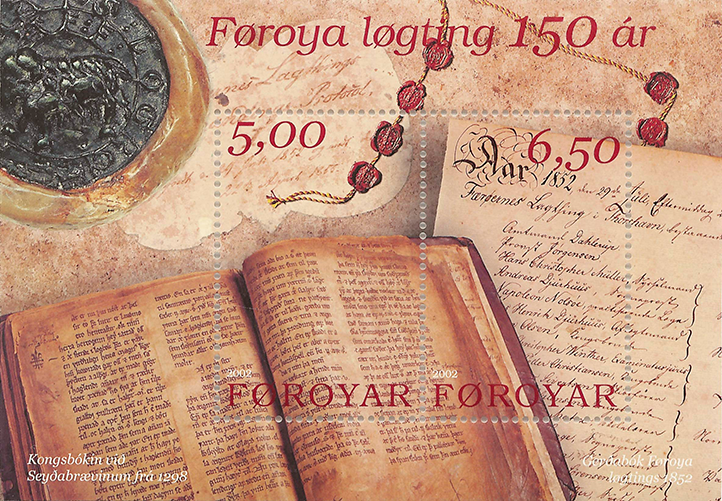
St.Olav's day, 29 July 2002, is the 150th anniversary of the re-establishment of the Faroese legislative assembly, the Løgting or Faroese Representative Council. Postverk Føroya is marking the occasion with the issue of a stamp showing two important documents in the history of the Løgting. One of these is the medieval statutory instrument of 1298 contained in the Royal book orKongsbókin, which is a medieval book of law, while the other is the protocol of the Løgting from 1852. Also illustrated on the block is the cover of the Løgting's protocol from 1852, and in the upper left corner is an insert with the ancient seal of the Løgting.
What is the connection between a statutory instrument dating from 1298 and an institution that has existed for 150 years? The explanation is that the history of the Løgting, the present Faroese Representative Council, can in fact be traced right back to the time of the Vikings.
The Faroese ting or assembly was originally a so-called alting, with both legislative and judicial authority. On the other hand, there was no executive authority in the country. The Faroese society was a family society, eitt ættarsamfelag, where the families saw to it that the judgements and resolutions of the Løgting were put into practice. After the Faroes became a Norwegian tributary country or skattland in about 1035, the influence and authority of the Faroese alting was considerably reduced. In the course of the fourteenth and fifteenth centuries the alting was transformed into a Løgting, with only judicial authority. Its president, the Løgmaður, was the presiding judge, and was from then on appointed by the king. The members were calledLøgrættumenn, which today means something like jurymen, and they were appointed by the King's Provost on the Faroes. In about 1380 the Faroes, together with Norway, came under the Danish throne, but the islands preserved their special status as former Norwegian territory. Regardless of these developments, the Løgting preserved a certain influence on the legislature and the administration of the islands until the introduction of the absolute monarchy in 1660. From that date the influence and authority of the Løgting was again reduced, and the institution was finally abolished in 1816. At the same time the judicial authority of the Løgting was transferred to other courts, such as the newly-inaugurated Court of the Faroes.
When Denmark received a free, and for that period democratic constitution in 1849, this signalled the end of the special status the Faroe Islands had held within the kingdom of Denmark. This was enacted without consulting the Faroese population. At that time many of them wished to see the Løgting reinstated, one reason being that they were not satisfied with the situation that the highest Danish government official, called the amtmaður, was the sole advisory authority on the Faroes on matters of Faroese legislation. Among those who campaigned for political rights of the Faroes was Niels Winther (1822-1892). When the Act of 23 March 1882 was passed it meant that the Faroese Løgting was to be reconstituted, although not as a legislative assembly, but as an advisory body, an amtsráð. The reconstituted Løgting held its first assembly on St. Olav's day (Ólavsøkudag) in 1852, and thus revived the traditions of the former institution which had been abolished in 1816.
Even though at that time the Løgting had only limited political authority and influence, the institution gradually gained in significance as the representative of the Faroes to the Danish government and parliament (the rigsdag) and as a political forum where politically conscious Faroese islanders could gain experience of politics. The Løgting became the political platform for the Faroese nationalist movement. One of the chief objectives behind the demand for political home rule which its supporters put forward was that the Løgting should have legislative powers.
The Faroese Løgting, its powers and its status have undergone substantial changes in the period from 1852 to 2002. In the assembly established in 1852, the amtmaður, the highest Danish government official, was ex officio the president of the Løgting. However, this rule was amended in 1923, so that the president was from then on elected by the members of the Løgting. In 1935 the Løgting was authorised to levy taxes, and during the second World war, when the Faroes were occupied by Great Britain and relations with Denmark were interrupted, the Løgting actually functioned as a legislative assembly. At the end of the War the independence movement was so powerful that none of the political parties were willing to return to the pre-war situation where the status of the Faroes had practically been that of a county. Long and laborious negotiations followed between the Danish government and the representatives of the Løgting, and after a referendum, in which a small majority voted for secession from Denmark, the Home Rule Act came into force on 1 April 1948. This Act granted the Faroese Løgting, which became the Faroese Representative Council, legislative authority in certain areas of the legislation, defined as særanliggender or matters of separate concern, while other areas are administrated by the Danish national authorities as fællesanliggender or matters of common concern. With the passing of a new statute in 1995 parliamentarism was legally adopted, and at the same time the structure and functions of the Løgting were modernised.
The Faroese Løgting which was reconstituted in 1852 is quite unique in the context of international parliamentary assemblies. The Løgting traces its history right back to the society of the Viking period around 825, which means that the institution can in fact be considered as one of the oldest legislative assemblies in the world.
Kongsbókin – the Royal book
There is a certain amount of evidence that the Faroes were already colonised as early as 650 A.D. The first inhabitants, who were of Celtic descent, were driven out by Norse landnamsmen in about 825 A.D. Faroese society in the Viking period and the Middle Ages resembled the other Nordic populations in may ways. This was particularly true when it came to legislation. The most important body of law was the Gulatingslógin, an ancient Norwegian agricultural law, which originated in the Gulating legislative area in Vestlandet in Norway. Originally this law was preserved through oral tradition, but it was written down about the year 1100. Important elements of this law can be found in the Norwegian 'law of the land' or Landslov, which came into force on the Faroes in about 1274.
A version of this law is written in a parchment manuscript called The Kongsbókin in the Faroese National Archive in Torshavn. The Kongsbókin, which is the only medieval parchment manuscript existing on the Faroes, is a book of laws. It consists of three sections: the Norwegian landslov, covering seventy one sheets, the Statute concerning sheep breeding on the Faroes (Seyðabrævið), covering four sheets, and three more recent sheets, the first of which was originally blank. On the other two there is a hand-written copy of a diploma issued by the Danish king Hans, dated 14 July 1491. Besides these there are three other texts in the Kongsbókin. The title of the book, literally 'the King's book', indicates that according to Faroese tradition the book belonged to the king – the public authority.
The Statute concerning sheep breeding on the Faroes (Seyðabrævið) in the Kongsbókin,
The Statute concerning sheep breeding on the Faroes (Seyðabrævið), dated 24 June 1298, is the most important source in the history of the Faroes in the Middle Ages, and is preserved in two separate books of law (as parchment manuscripts) from the Middle Ages. One of these two books is the Kongsbókin, while the other is a book of laws preserved in Lund in Sweden, and it is therefore known on the Faroes as the Lundarbókin or the Lund book (Medieval manuscript no. 15, the University Library in Lund). The manuscript in Lund, which was originally written in Norway by a Faroese cleric, is one of the most beautiful medieval manuscripts in Scandinavia. The Lundarbókin is a magnificent ceremonial copy, while the Kongsbókin is a working handbook. For may years it was believed that the Statute concerning sheep breeding on the Faroes (Seyðabrævið) in the Kongsbókin was a copy sent to the Faroes by the Norwegian duke Håkon Magnussen, whose duchy included the Faroes. However, it is now almost certain that this text is really the original manuscript. This is thus the oldest preserved copy of the Statute concerning sheep breeding on the Faroes (Seyðabrævið). The manuscript was presumably drawn up in collaboration with Faroese clerics, and there is also evidence that this manuscript was originally written on the Faroes. At a later date the manuscript was then incorporated in the Kongsbókin.
Other texts in the Kongsbókin
The first text is a statute passed by the Løgting in about 1400, dealing with payments to the members. The text was presumably written by a Faroese islander. The next is a short legal text written on a sheet of parchment which is attached to the book. The third text was written on the back of this piece of parchment. The text, which dates from around 1400, concerns four sisters from the island of Skuø.
Below the text on three pages of the book of law there are some regulations on the keeping of dogs in various Faroese villages. These regulations have been drawn up by a certain president of the Løgting called Simon and some of the members. The regulations are usually known as the Hundabrævið (the dog regulations). Although the person who wrote the regulations was obviously able to write, the text is extremely difficult to decipher, because the parchment is worn and faded in places. For this reason the text has in fact never been read in its full length.
Kongsbókin – a parchment manuscript with a dramatic history
The Kongsbókin has had a dramatic history, and it is really a miracle that it has survived. The book originally belonged to the Faroese Løgting. The president of the Løgting, who at that period held the title of Løgmaður, was responsible for keeping the book safely. The last Løgmaður to keep the book was Pætur Jákupsson from Kirkjubø. Pætur Jákupsson had Kongsbókin rebound in 1599 and at the same time had his own name embossed on the front of the book, while the date 1599 was embossed on the back of the volume. Although the Kongsbókin clearly shows signs of having been in use in the Faroese Løgting for about three hundred years, it is still a magnificent and beautiful manuscript.
The Kongsbókin was preserved in Stockholm for two hundred years, but at the present date it is not known how the book first came from the Faroes to Stockholm. We do know for certain, however, that Pætur Jákupsson brought the book to Bergen in about the year 1600, and from there it arrived in Stockholm about a hundred years later, and was kept in the royal cabinet of curiosities. At a later date it was entrusted to the Royal Library in Stockholm. On 7 December 1989 the Swedish Rigsdag resolved that the Kongsbókin should be returned to the Faroes. On 28 August 1990 the Swedish Minister of Culture presented the Kongsbókin to the Faroese national assembly at a ceremony in the Løgting, and it was entrusted to the Faroese National Archive, where it is preserved together with the other archives of the Løgting.
The Løgting's seal
On the stamp block is a picture of the Løgting's oldest preserved wax seal. This seal is attached to a letter from bishop Ámund Ólavsson and the president of the Løgting Andrass Guttormsson, and it shows the ancient Faroese coat of arms, a ram. The date on the letter is: Thorshavn in die assumtionis Marie anno domini mdxxxiii, which is Latin for 15 August 1533. The seal bears the following inscription: S:LOGRETTVMANNA A:F., which translates as Sigillum løgrettumanna af Færøeyum. The actual seal which was used to stamp the wax seal dates from the fourteenth century.
The Løgting protocol 1852
When the Faroese Løgting was reconstituted in 1852, the protocol, which is depicted on the stamp block, was authorised as the record of the assembly and furnished with the Official Seal of the Faroes. On the stamp the protocol is shown opened at the record of the first assembly on St. Olav's day in 1852 at 1 p.m. The assembly was held after the service in Torshavn church. Thus the new Løgting resumed the old tradition of beginning the session on St. Olav's day (Ólavsøkudag) with a service and then a procession from the church to the Løgting house.
History of the Løgting well documented
The protocols of the Løgting assemblies and its other archives from 1852 up to the present are kept at the Faroese National Archive in Torshavn. The Løgting's protocols from 1615 to 1816 are also preserved at the National Archive. The total archives of the Løgting contain the most important sources of Faroese history. Thus the Faroese Løgting is a parliament with an exceptionally well-documented history, where the archives in fact cover the period right from 1298 to the present. There are only a very few parliaments in Europe with archives preserved to the same extent where the records are continuous both through time and in their contents.
Together with the other texts in the Kongsbókin, the Statute concerning sheep breeding on the Faroes (Seyðabrævið) contains information on conditions in society, the economy, the language, culture and cultural history. The Løgting's archives from 1615 to 1816 contain similar rich sources of material on all aspects of the history of the Faroes in that period. The Løgting's archives for the period from 1852 to the present also provide the most important source of information on the more recent and latest political history of the Faroes. The Faroese cultural heritage is founded on this abundance of source material, which is thus at the very heart of the Faroese identity and sense of history right from the landnam period to our own time.